Showing posts with label cerebral palsy specialist in india. Show all posts

Tuesday, 26 March 2013

Feeding Children with Spastic Cerebral Palsy

In cerebral palsy there are 3 biggest problems that the spastic children are – the body is in a poor position, the jaws are tight, the tongue pushes the food forward. Swallowing is difficult because of some reasons like head pushing back, jaw and lips are not closed, the bottom lips tend to bitten in by the top set of teeth or mouth is wide open, tip of tongue is down behind the teeth, the tongue cannot roll the food back to mouth or there can be chewing problem.
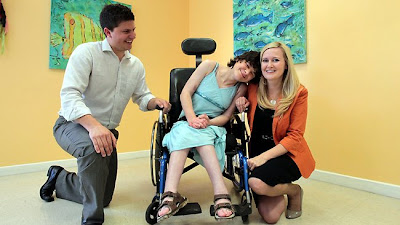
Child of Cerebral Palsy

There are also some problems with breast feeding or feeding by bottle. The child would push back his head and body and their legs and arms would get stiff. They cannot suck and swallow easily. So it is very important that the head and body should be in correct position, all the muscles of neck and jaw must be relaxed, jaw must be back and not clenched, the lips must be together and the tongue must be able to move the food from side to side in the mouth.


To breast feed or by a bottle a child with cerebral palsy the head must be in forward direction so that he can swallow more easily. The baby must be in half sitting position with hips bent and the mother must keep the shoulders of baby in forward direction by pushing firmly on the chest. In feeding by bottle the teat of bottle should be bigger in size so that it would not choke.

The therapist should concentrate to control jaw movement in the child. If the therapist teaches a child how to control his mouth, particularly his jaw, then sucking and swallowing, spoon feeding from plate and drinking from a cup can be improved. To teach a child the therapist should sit in a chair facing the child’s face. The therapist can put the child on his lap or on standing frame (it simultaneously relax the muscles of whole body during feeding).

The position of child should be decided according to child’s age and ability. The therapist should stabilize the head then clasp the jaw and the index finger should be kept on the jaw of the child. The therapist should push the jaw backward (not downward) and push the bottom lip up, as this is necessary for swallowing. The third finger is put under tongue, to help the tongue move. The other fingers are lifted away from the child’s face. To reduce the Plasticity the therapist should use his right index finger and introducing inside the child’s mouth he should move the finger in semicircle on the top gum from middle to left then to right side. This is done firmly and not too fast. It is done 3 times and the child is encouraged to swallow by the 3rd finger of the left hand moving from forward to backward.

The therapist must also concentrate on hand activities (prehension and precision) to teach the child to hold plates and spoons to feed themselves. While teaching therapist must work on dominant as well as non-dominant hand. The non-dominant hand should be stabilized during activities of dominant hand and vice versa.

The swallowing activities also depend on quality of food. It must be started from liquid then semisolid and finally solid. Only metal teaspoon must be used to feed a child. Small amount of food must be put on the teaspoon. The spoon must be put right in the mouth and pressed down to the tongue. By doing this the tongue will be encouraged to stop pushing the food forward and the child will be able to use his lips better. To teach drinking water or milk the therapist must correct the shape of the plastic cup.

Cut a semicircle at the mouth of one side of plastic cup so that the child will not push his head back to get the liquid. Keep the cut part upward and put the cup on top of bottom lip and then tilt the cup slowly upward. The therapist must demonstrate all activities to child’s mother so that she will learn how to feed his child.

Author Bio:

Kanhaiya Jha is working as Sr. Associate - Internet Marketing. Get in touch with him on Facebook here.

Wednesday, 27 February 2013

NeuroDevelopmental Therapy in Cerebral Palsy

NDT is a technique to facilitate the movements which are not present in the Cerebral Palsy children.

Facilitation is a process in which therapist hand gives a direction to the child’s body how to move. In this technique therapist holds the complete control of child’s body weight and the movement. Therapist gives a direction to the body to shifts its COG (Center of Gravity). As the COG shifted to some direction the control over the balance in the child is lost. Therapist should teach the child how to gain control again, by shifting weight to another side. This whole procedure is the part of NDT.


Equipments used in the NDT are Ball, Bolster, or Table/Bench.

Equipments are to challenge the body weight, to help accommodation the structural deformities of the child. These facilitation techniques are used improve the postural control of the child by challenging the posture.

BOLSTER/ROOSTER: is devices which is used to for prone, sitting and sit to stand facilitating techniques. It should be firm, provides a mobile surface that is easy to control because it rolls predictably front to back when child lies prone or sit on it.

BALL: is the most challenging device for the facilitation techniques. It is not firm because it can move in any direction and the base of support is very less.
There are two type of cerebral palsy according to the tone, Hypertonic and Hypotonic. Facilitation is given according to the tone of child. Hypertonic child is given facilitation techniques to decrease its tone and to improve its posture. Hypotonic is given different facilitation to increase the tone and posture.
 

First of all we should check the child’s stage and milestones before taking in the NDT.

Neck holding is the first step which should come in the child if it is absent then just facilitate neck extensors to extend the neck. On bolster put child in prone then ask him to hold the neck in extension by facilitating trapezius muscle or taking the shoulders in retraction. On ball put child in creep/crawl positions then the same facilitation done. Facilitation on the spine can also be done to make spine in extension and neck in hold position.

Quadruped position is the next position attends by the child. In this weight bearing on all four limbs is essential. So the power on all four limb must be good. This posture is attended on the ball. We can make it more challenging by rolling the ball so that the COG of the child’s body shifts and the opposite muscles work to prevent a fall.

Pelvic control facilitation techniques can be done on the ball and bolster both. On the bolster we can make child sit and the roll the bolster to shift COG and facilitate muscles to prevent any fall. Like this we can make child sit on the ball and can move ball too to shift the base of support and facilitate muscles. On ball different positions can be attended like cross sitting, kneeling, sitting by legs open wide on ball, sitting and hands are extended and sitting with hand in overhead position. Rankly decrease base of support and increase pelvic control. In all these positions we can facilitate pelvic muscles by rolling ball, shifting base to either side, ask child to reach an object to either side, make base less supportive by tilting ball on opposite side. All these make the muscles work and repetition of this strengthen the muscles.


The main purpose of the NDT is to improve balance with less support. Facilitation technique is more effective then passive movements. Resistive exercises are difficult in cerebral palsy child because they are not so cooperative and not following commands. So the most effective technique is NDT in the cerebral palsy.

My name is Babuli Nayak and I am an internet marketer at Daffodil Software. I have a clear understanding of Organic Marketing and have 4 years experience.